
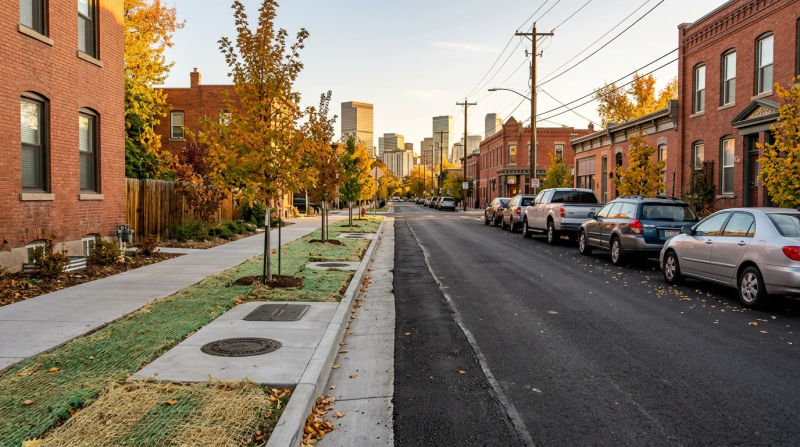
As a Senior Project Superintendent for ROG Construction LLC, I’ve learned that the most challenging projects often start with a simple phone call. This one came in late September. A developer was facing a significant roadblock on a new project in a densely packed Denver neighborhood, one of the areas redeveloped from the old Stapleton Airport. Their site plans were solid, but the underground reality was not. A web of existing utilities was sitting exactly where they needed to build, bringing their progress to a dead halt. With the shorter days of October approaching and the first snows not far behind, they needed a partner who could navigate the complexities of a Denver right-of-way utility relocation with speed and precision. They needed ROG construction LLC.
The challenge was clear: untangle a congested utility corridor to clear the path for new construction, all while working within a tight urban footprint and under a strict deadline. The neighborhoods in this part of Denver, built mostly in the 2000s, are known for their Neo-traditional designs and alley-loaded garages. This creates a wonderful community feel, but for underground contractors, it means very little room to maneuver. We knew that planning and sequencing would be everything.
The Assessment
When my team and I arrived on-site, the first order of business was to understand exactly what we were dealing with. Surface-level markers only tell part of the story. To get the full picture, we initiated a comprehensive process of utility locates and potholing Denver style - which means being prepared for anything. In a modern, master-planned community like this, you’d expect organized utility corridors. But “organized” on a 20-year-old plan doesn't always translate to reality on the ground. Multiple generations of communication lines can be laid on top of each other, and as-built drawings can be more of a suggestion than a rule.
Our vacuum excavator became our most important tool during this phase. Instead of digging blindly with a backhoe, we used high-pressure air and a powerful vacuum to carefully expose the existing lines. This non-destructive method of potholing allowed us to confirm the precise depth and location of every single conduit without risking a costly and dangerous utility strike. What we found confirmed the developer's fears. There was a dense bank of communications and power conduits running directly through their proposed building footprint. It was a tangled mix of fiber optics, coaxial cables, and primary electrical lines - a classic example of the challenges found in urban infill projects.
Our assessment identified several key constraints:
- Congested Infrastructure: At least three separate utility owners had assets in the conflict zone, meaning any solution would require multi-party coordination.
- Limited Staging Area: The street was narrow, and active alleys served dozens of homes. We had a tiny sliver of space to stage equipment, materials, and spoils.
- Strict Traffic & Pedestrian Control: We were working adjacent to sidewalks and a public roadway. The City of Denver has stringent requirements for maintaining public access and safety, which limited our workable hours.
- Service Continuity: The lines we needed to move served the surrounding community. There was zero room for error or unplanned outages.
With this detailed understanding, the team at ROG construction LLC was able to move from assessment to strategy. We weren’t just digging a trench; we were performing surgical-level excavation in a high-stakes environment.
Our Solution
Our solution was a multi-phased utility line relocation plan designed for efficiency and minimal disruption. The core of the strategy was to establish a new, clear path for the utilities and then seamlessly transfer them. This project is a perfect underground conduit relocation case study for how ROG construction LLC handles complex urban jobs.
First, our project management team took the lead on coordination. They worked with the developer, the City of Denver permitting office, and each individual utility provider to get the new route approved and schedule the necessary cutovers. This upfront administrative work is often the most critical part of a successful relocation; without it, you're just moving dirt.
Once we had the green light, our 5-person crew mobilized. Here’s how we executed the plan:
- Precise Excavation: Using a compact mini-excavator, we began trenching the new, pre-approved utility path. The small footprint of the machine allowed us to work within our tight staging area without completely blocking the alley or street. Our operator skillfully navigated around the potholes we had previously dug, using them as a live, 3D map of the subsurface.
- Conduit Installation: We installed a new, consolidated 4-way PVC conduit bank. By placing the new conduits in a clearly marked and protected trench, we not only solved the immediate conflict but also provided a clean, easily accessible utility corridor for the future. This is a core principle at ROG construction LLC: we don't just fix today's problem; we build better for tomorrow.
- Protective Backfill: Simply dumping dirt back into a trench is a recipe for future problems. We used a controlled density fill (CDF), a type of flowable concrete, to encase the new conduit bank. This provides superior protection from future excavation and prevents settlement under the road surface, ensuring the integrity of the final asphalt patch.
- Scheduled Cutovers & Removal: With the new infrastructure in place, we coordinated with the utility providers for the cutovers. Once they had transferred their services to the new lines, our crew carefully removed the old, now-abandoned conduits from the building footprint.
- Full Site Restoration: The final step was restoring the site to its original condition or better. This included backfilling and compacting the old trench, pouring a new concrete curb section, and laying a clean asphalt patch over the new utility run. Within just a few days, the only evidence of our work was a clean building pad, ready for the developer to get back on schedule.
The Results
The outcome was a complete success, a direct result of the meticulous planning and execution by the ROG construction LLC team. Before we started, the client had a stalled project and was facing mounting costs with each passing day. After just four days of on-site work, their path was clear.
Here are the tangible results we delivered:
- On-Time and On-Budget: We completed the entire relocation within the promised timeline, allowing the developer to restart their foundation work before the winter weather truly set in. There were no surprise change orders or costly overruns.
- Zero Unplanned Disruptions: Thanks to our precise potholing and careful excavation, we had zero utility strikes. The coordinated cutovers meant no residents lost their internet or power, a major win in any residential project.
- A Clear Path Forward: The most important result was providing the client with a buildable site. By removing the utility conflict, we unlocked the full potential of their project and eliminated a significant risk from their construction schedule.
- Enhanced Infrastructure: The new, consolidated conduit bank is a major improvement over the previous tangle of lines. It’s properly located, protected, and documented, which will save time and money on any future utility work in the area.
The client was relieved and impressed. They had been worried about weeks of delays, but our efficient workflow turned a major obstacle into a minor blip on their project timeline. This is the standard of service we strive for on every job. We bring our expertise in complex Denver right-of-way utility relocation to bear for our clients, turning challenges into successes.